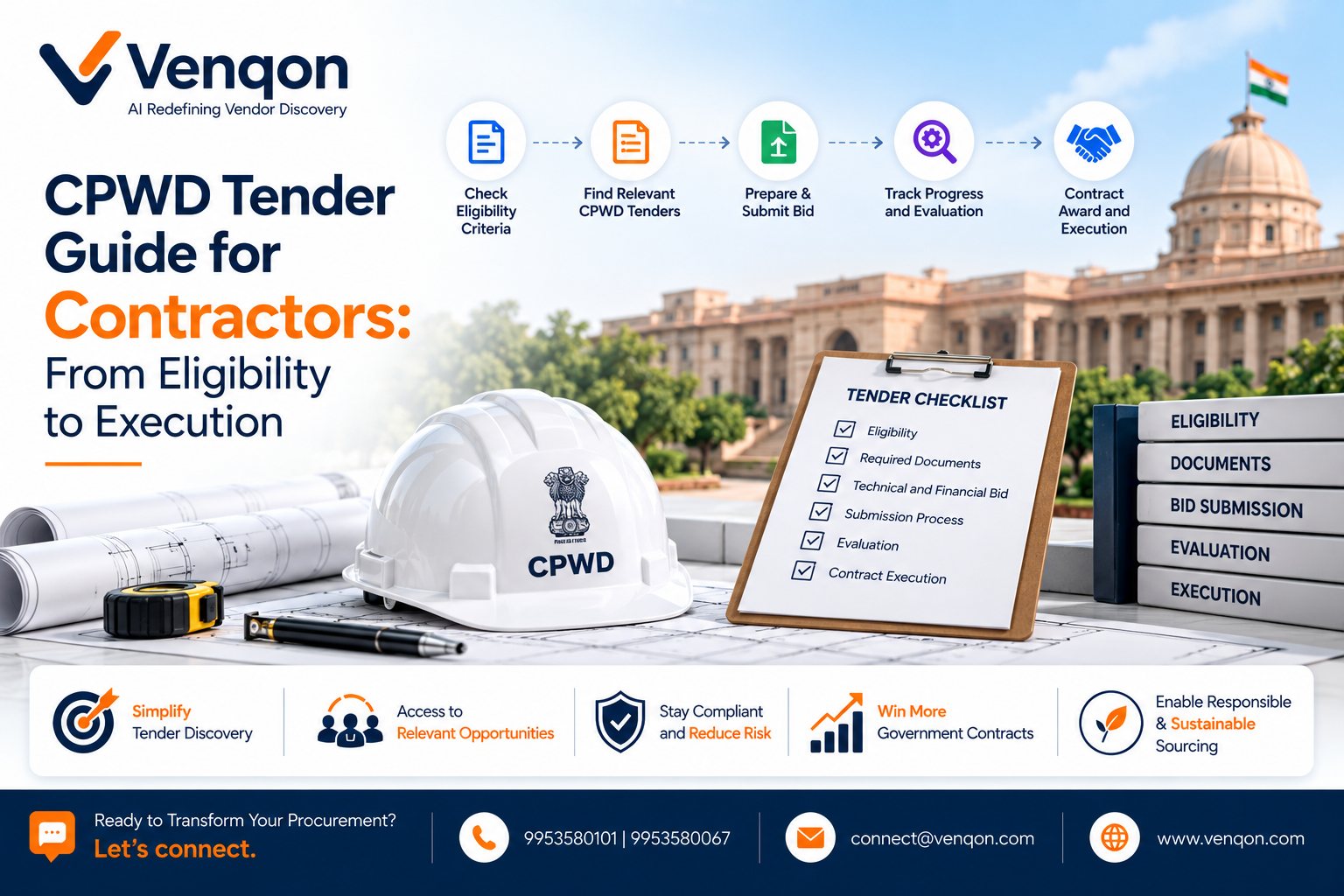
The opportunity for contractors to participate in public infrastructure projects (facilities, systems, and structures that are government-owned and operated for public use) is substantial, but a thorough understanding of the CPWD tender process is essential for successfully securing and executing such projects. The Central Public Works Department (CPWD) is no longer limited to offline paperwork. Today, the entire process has become digital. CPWD uses e-tendering for its works, with tender notices published through its designated official CPWD e-Tender website and linked government procurement platforms.
Securing a CPWD tender contract can be a lengthy process. From exploring opportunities with the Central Public Works Department spanning buildings, services, maintenance, and infrastructure to checking CPWD tender eligibility, tender planning is a crucial process that requires careful attention from businesses operating in national and international markets. Contractors may need to undergo the formal CPWD enlistment process, where required, and carefully review the tender’s definitions of similar work, completed work value, and applicable time periods.
The procedure further involves preparation of vital documents like Earnest Money Deposit (EMD), GST Registration Certificate, Work Completion Certificate, Turnover and Financial Statement to prove their financial stability.
This article discusses the important steps contractors need to know before participating in the CPWD tender.
CPWD tender is an official invitation published by the Central Public Works Department for eligible contractors, suppliers, and service providers to submit bids for specified construction, infrastructure, electrical, maintenance, or other works. Tenders are released across various categories, including civil works, electrical works, maintenance, and procurement. A CPWD tender document is a crucial part of the entire procurement process and provides a wide range of information about the specific public-sector construction project in India that your business is interested in pursuing. It outlines the scope of work, estimated cost, detailed specifications of what needs to be delivered, eligibility conditions, timelines, submission requirements, and contractual conditions and invites bids from contractors, suppliers or service providers for a specific project or service helping ensure that the procurement process is conducted smoothly.
CPWD tenders are generally published through the CPWD e-Tendering Portal, the Central Public Works Department’s dedicated online procurement platform. The portal simplifies the government procurement process through a fully digital and transparent process for awarding infrastructure projects. Contractors should regularly monitor the relevant portal and other government procurement platforms and other government procurement platforms to identify suitable opportunities and turn national development aspirations into concrete infrastructure assets.
CPWD tenders serve as a primary means of securing new construction projects and cover central public-sector infrastructure works across India. But before preparing a bid, contractors should thoroughly review the tender documents and assess the requirements before making a final decision. These documents, which are essentially a transactional model between the companies and government bodies, typically outline the eligibility criteria and help determine whether contractors, suppliers, and service providers meet the CPWD tender eligibility conditions specified in the Notice Inviting Tender (NIT).
Eligibility can depend on factors such as:
Tender eligibility criteria and growth opportunities can vary sharply according to the nature, value, and complexity of the project. Therefore, contractors should not assume that passing the tender submission process for one tender means they meet the eligibility requirements for another tender.
Bidding on a CPWD tender can open opportunities for growth and revenue, but carefully reviewing the tender documents is one of the most important stages before submitting a bid. Depending on the tender, contractors or bidders may need to submit crucial information and supporting documents, such as GST registration certificate, purchase order details, etc, under the “My Documents” option during bid submission. These documents should define eligibility, experience, financial capacity, registrations, technical qualifications, declarations, and other prescribed requirements.
Every year, CPWD releases thousands of tenders. If you are considering participating in government construction work and bidding for a CPWD tender, the process generally begins with identifying a suitable tender and carefully studying its NIT and accompanying documents, including the tender conditions, scope of work, eligibility criteria, and bidding process.
The first step is to analyze the available tender opportunities and identify those that match your category, technical expertise, experience, geographical scope, and available resources. You do not need to pursue every tender opportunity; instead, focus on tenders that align with your capabilities and where you meet the specified requirements, to craft a strategic and responsive tender submission.
Carefully read through the eligibility and qualifying conditions to assess if you are eligible for participation in the tendering process. It is important to confirm whether your enlistment, experience, financial capacity, and other qualifications meet the required conditions before you spend considerable time preparing your tender.
The tender documents are generally available in PDF format, which is easily accessible, storable, and reviewable for future study and analysis purposes. It is advisable for the bidders to read through the tender documents, which include the scope of work, technical specification, drawings, BOQ, contractual provisions, deadlines, and submission requirements to extract all necessary information prior to the submission of their bid. Contractors/bidders who have registered for the CPWD tender must be aware of any amendments or changes made officially in the course of the tender process.
CPWD tender rate analysis is crucial for preparing a commercially viable financial bid and involves more than simply submitting the lowest bid. When conducting a thorough rate analysis, contractors should assess material costs, labour, equipment, transportation, overheads, applicable taxes and duties, site conditions, wastage, potential risks, and expected profit margins.
The objective should be to develop a detailed breakdown of the actual cost of executing the work and then assess whether the CPWD tender rate is commercially sustainable.
Preparing and submitting the bid requires a proper strategy for both the technical and financial bids. Complete the required technical and financial information in accordance with the tender instructions. Carefully check all uploaded documents, declarations, digital signatures, fees or securities, and the financial bid, which states the evaluated commercial offer in the prescribed format, before submitting the bid through the e-tendering system.
CPWD’s Works Manual states that all tenders, irrespective of their value, shall be invited through the e-tendering system. It also specifies standard periods for tender submission, with publicity and submission periods varying according to the tender value and bidding system.
Securing a CPWD tender opportunity is only the beginning of a contractor’s role. Once the project is awarded, the contractor is bestowed with the responsibility of executing projects that contribute to the construction and maintenance of public buildings and infrastructure across India.
After the award, the contractor must comply with contractual requirements, mobilise resources, coordinate with the relevant CPWD authorities, and maintain quality and safety standards while ensuring the project is completed within the stipulated conditions and timeframe.
Effective execution also requires regular monitoring of materials, labour, equipment, progress, documentation, measurements, and billing. The contractor must proactively monitor and respond to any changes or instructions issued during the project.
Venqon helps contractors discover relevant projects in infrastructure, buildings, horticulture, and maintenance across the country by listing CPWD tenders across categories such as civil works, building construction, roads, bridges, electrical installations, and other infrastructure services that play a pivotal role in nation-building. Its platform supports effective tender management by helping contractors search for relevant tenders using filters based on their requirements, while also delivering relevant CPWD tenders directly to their registered email address.
Venqon provides information on CPWD, one of the widely known government construction departments in India. It also assists contractors with tender-related information, document collection, and bid filing, helping establish a foundation for participating in government construction works.